
Heavy February clouds blanketed the sky as we wound through Marrakech in a taxi. Bus stops sported ugly, peeling posters, and donkey carts sat stalled on the shoulders. Diesel fumes hung heavy, and countless men on squat 100cc motorbikes wove through the sluggish traffic.
We’d flown out of Kenya the night before. After exiting the cab, my husband, Tom, and I awkwardly loaded our boxed bikes onto a handcart because vehicles are not usually allowed in medinas, the historic hearts of Morocco’s medieval cities. Our guesthouse owner met us at one of the worn city gates that breached the medina’s stone walls. Women in colorful headscarves crowded the streets as he led us through the maze of narrow alleys.

We soon entered a market square filled with pyramids of fresh oranges, lemons, and pomegranates. Adjacent stalls displayed towers of rainbow-hued spices: curry, paprika, oregano, and even saffron, which is worth its weight in gold. Other booths sold nuts and syrup-covered sweets. Yet more merchants hawked handmade wool rugs, clothing, and all manner of household items. Every inch of cacophonous space was in use, and our eyes were wide.
Because I was still fatigued and underweight from my illnesses in Rwanda, we mapped out a cautiously flat route that connected the imperial cities of Meknes, Fes, Chefchaouen, and Tetouan. Dates and slow-cooked, stew-like tagines were helping me regain strength, and I hoped that trend would continue during our month riding in northern Africa. Once we reached the north coast, we’d cross the Strait of Gibraltar to Spain.
After exploring Marrakech for a few days, we cycled northeast through farmlands with the snow-capped Atlas Mountains looming in the distance. After 50 flat miles, it was time to camp.
“I can’t believe this,” I told Tom. “The hospitality. The openness of landscape — and heart. I feel so lucky.” Little did we know how many times similar scenes would play out over the following weeks.
Uncertain of local customs, we hesitantly asked to stay the night at a mosque. The Quran and Islamic teachings both stress the rights of the traveler, but we couldn’t know how that would play out in reality.
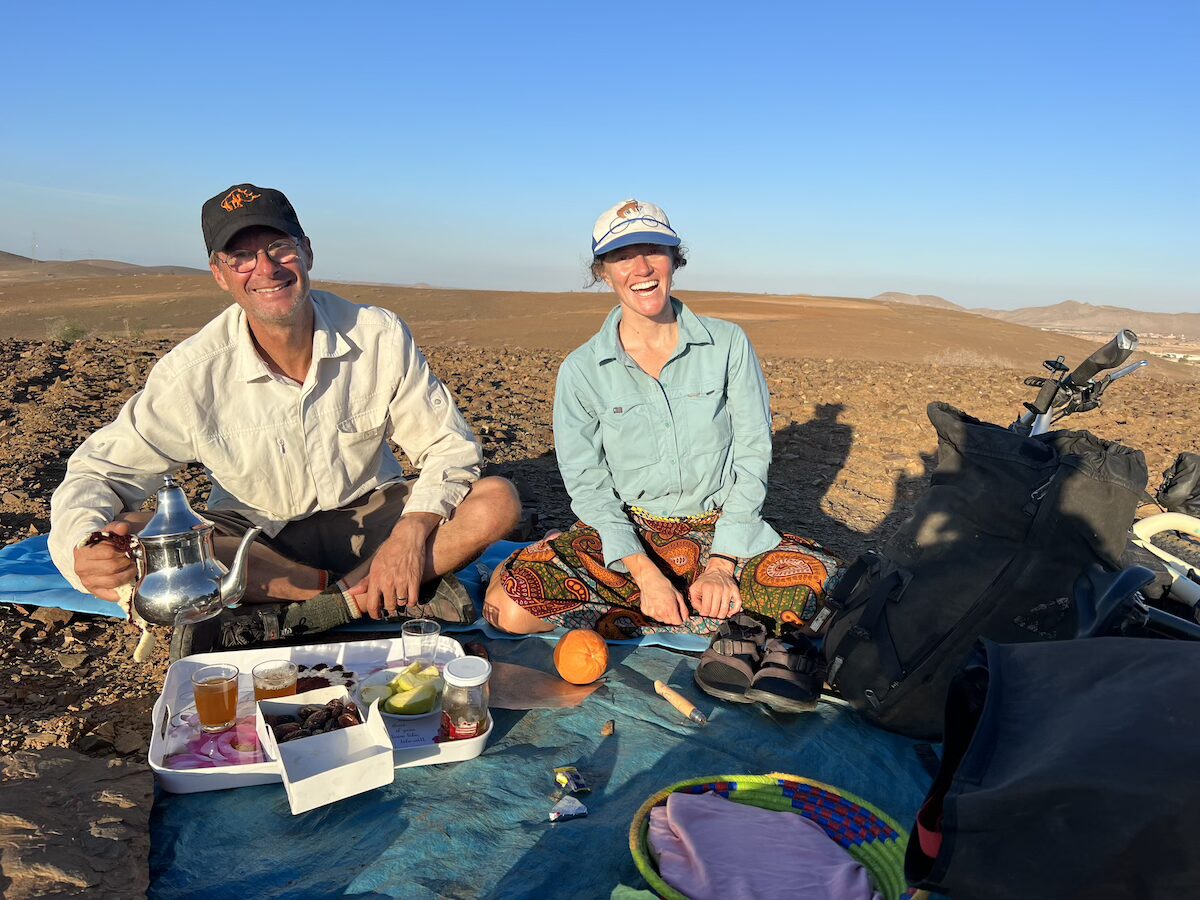
Abdul Ghani was the only one standing outside the mosque, and the seamster and shopkeeper responded to our request with a warm nod. Then he guided us across a half mile of dry, furrowed fields to a high ridge where views of stony, windswept earth unfurled for miles. “One of my favorite places,” he confided before leaving us to set up our tent.
Soon, he returned carrying a tray of tea, sliced apples, and a jar of cloudy, homemade olive oil. He held the silver tea pot high and dramatically poured its minty contents into three gold-embossed glasses. He left after tea only to return in the orange glow of evening with his two daughters. They sang traditional songs of the Amazigh, a name for the various North African ethnic groups whose presence predates the Arabs. They lit a small fire with thorny brush sourced nearby and bid us goodnight. Stars pin-pricked the onyx sky. A crescent moon rose.
“I can’t believe this,” I told Tom. “The hospitality. The openness of landscape — and heart. I feel so lucky.” Little did we know how many times similar scenes would play out over the following weeks.
We spent the next few days riding past acres of olive trees, their peppery scent coating the air. Mustachioed men lingered in cafes, smoking cigarettes and drinking espresso. Twice, truck drivers stopped to give us warm, smoky rounds of bread sprinkled with wheat germ, a local staple. Before we could protest, they pointed to the sky with calloused hands and said, “Inshallah,” meaning “Allah willing” or “Allah wills it.” Despite struggling with basic Arabic pronunciations, we quickly learned how to say thank you — shukran.
Locals invited us to their homes for tea most days. “Why are you here?” they asked. “Where are you from?” We indulged in dates, honey, walnuts, butter, za’atar seasoning, pistachios, and unleavened breads while sheep herders, farmers, ranchers, and weavers stared at us across their tables. We handed phones back and forth, and, using Google translate, they told us of their lives and asked about ours.
One windy afternoon south of Khenifra, an inland city almost halfway along our route, Tom’s phone fell off his handlebar mount. After an hour of searching, Tom retrieved it thanks to Abdul Salem, a sheep herder who’d found it in a ditch. Abdul refused Tom’s offer of dirhams, the local currency, and pointed to the sky. He motioned for us to proceed to his stone house.
We sat at low tables in a red room stacked with handwoven rugs. His wife brought the customary tea, along with bread, bowls of warm milk, butter, and honey. Her gray-blue eyes danced as she pulled a golden velour caftan over my head for a photo. It smelled of rosewater. She insisted that I keep it. “I cannot accept such an extravagant gift,” I countered. “Plus, I have no room in my bags.”
She unbuckled my rear panniers, placed the garment inside, and said, “See? Room. You have it.” Smiling, she added, “Inshallah.”
A few days later in Fes, one of the world’s oldest cities, we carried chairs up to our guesthouse’s roof to watch the moon rise and sun set simultaneously. Below, the square buildings glowed tan and red. A chorus of the Maghrib, the evening call to prayer, rose from nearby mosque towers. Under the moon, the green tiles on the nearest spire seemed to hum as unfiltered melody filled the air.

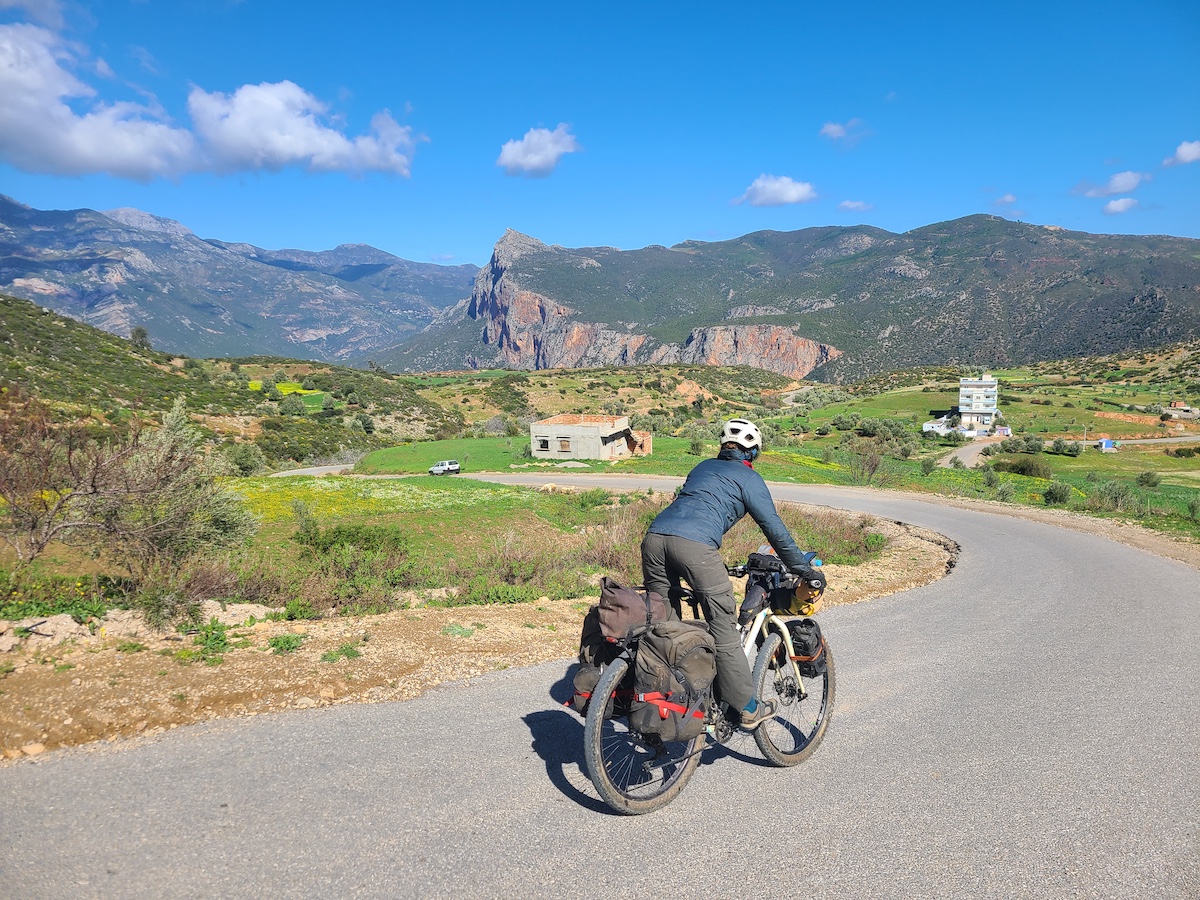
After Fes, we pedaled our gift-laden bikes north. My legs felt strong again, and we tackled a few steep climbs and enjoyed smooth descents on ribbony asphalt to the Mediterranean.
As February came to a close, coastal tailwinds pushed us to the town of Ceuta, an ancient Spanish exclave on the African coast, and within an hour, we were on a ferry to Europe. Africa had shifted something within us, reshaping our sense of hospitality and the quiet strength of kindness. Leaning back in our seats, we felt gratitude for each gesture and each stranger-turned-friend, and we smiled with eyes closed.
Editor’s note: This story originally appeared in the Spring 2025 issue of Adventure Cyclist magazine. Become a member today to follow Hollie’s journey around the word.
The post From the Magazine: Hospitality in Morocco appeared first on Adventure Cycling Association.