
Greg Lemond famously said about cycling:” It doesn’t get any easier. You just get faster.” And for a sport that values the ability to suffer, the least easy of all races is Paris-Roubaix, variously feted as “the Queen of the Classics” and cursed as “the Hell of the North.”
– Review by Leslie Reissner –
In 2006, L’Йquipe published a gorgeous history of the race and it is this book, in an excellent idiomatic English translation by cycling historian David Herlihy and published by VeloPress in 2008, that remains one of the few English-language books dedicated solely to this great event. This in itself merits its inclusion on a cyclist’s bookshelf, but the book has intrinsic qualities that make it a must-have.

Paris-Roubaix is a throwback to another age. When it began in 1896, the velodrome ruled the land and road races were the exception: difficult to organize and with only a few racers, unable to compete for the rich prizes of the tracks, available to participate. To enliven proceedings, some velodrome owners promoted road races to end at their tracks. This was the case of Paris-Roubaix, and the first race was so novel and popular that part of the grandstand collapsed under the weight of spectators. The winner, the German strongman Josef Fischer, completed the race at an average of over 30 km/h.

So this race had everything: an international field, a challenging route and an international field. It has gone from strength to strength as the other classics from that era (Paris-Mons? Paris-Rouen? Bordeaux-Paris?) are long gone, along with most of the ve
lodromes. This book covers the race from its beginnings, a time when cobblestones were commonplace and men and bikes seemed to have been made of iron, to today’s carbon-fiber age but the race has always been brutally hard, a merciless test of men and equipment.

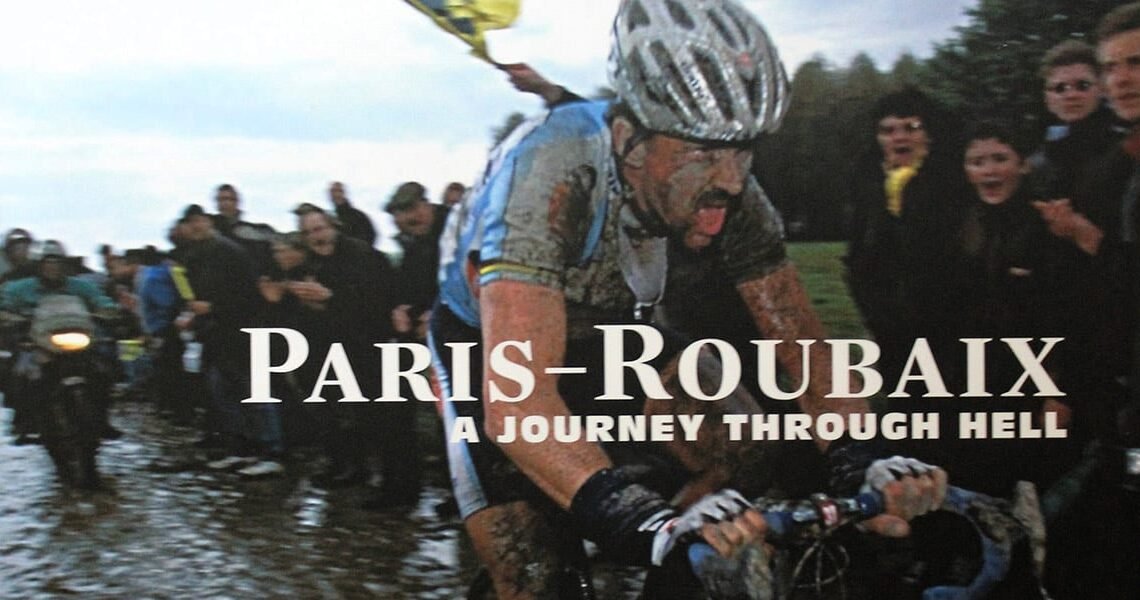
The authors have approached the race in a clever and unusual fashion. Rather than following a chronology, the majority of the eleven chapters of Paris-Roubaix: A Journey Through Hell are divided into different aspects of the race. These include: the cobblestones themselves; the impact of the weather; messed-up finishes; unexpected winners; the Roubaix velodrome; and a brilliant chapter devoted to the effects of getting a flat tire. There is a gallery of the most celebrated winners and the whole book is stuffed with marvellous photos taken from the archives of L’Йquipe. There appear to have been photographers present at every dramatic crash, or else there are always so many crashes that you just have to stand around and wait.

The race has attracted cycling’s greatest figures, who seem to have always had a love-hate relationship. Bernard Hinault felt that Paris-Roubaix was a ridiculous race, a lottery where chance ruled but he knew that posterity demanded that he win Paris-Roubaix. He did it in convincing fashion in 1981, wearing the rainbow jersey of the World Champion, and crushing five opponents (four of them previous P-R winners!) in the final sprint at the velodrome.
Although the race counts several other Tour de France victors among its winners, including Garin, Lapize Coppi and Merckx, it is more notable for its special “hard men,” who have specialized in beating the cobbles, such as four-time winner Roger de Vlaeminck, three-time champion Francesco Moser and the indomitable Gilbert Duclos-Lassalle, who participated in the race seventeen times, finally winning on the 14th attempt and repeating the following year. Their stories are all told in loving detail in this book.

Details indeed. There is a section recounting how Jean Stablinski, a former World Champion, suggested a particular section of cobbles to the race organizers and the famous Wallers-Arenberg stretch, a positively medieval piece of road, was added in 1968.
The modernization of France meant the removal or paving over the cobbles that are such a characteristic (and feared) part of the race and by 1968 the race against time was on as the countryside was scoured to find more cobbled roads. At its lowest point in 1965, the Queen of the North had only some 22 kms of cobblestones in its 294 km route. Today efforts have been made to protect and preserve the famous roads and the pros can look forward to more than 50 kms of pavй in twenty-six sections. And the mud and the dust are with us always.

And the people who protect and preserve the roads are the subject of the last chapter, “The Angels of Hell.” Described as the “guardians of the temple,” these include journalists, fans and even the artist, who painted 12 kilometers of cobbles (using 18 tons of paint) as a work of art and a tribute in 1986.

This is the kind of insight so lovingly presented in Paris-Roubaix: A Journey through Hell. Time has seen some adjustments to the race. It has been renamed “Paris-Roubaix Hauts-de-France” now and a women’s edition of the race was added in 2021. The book also does not contain a reference to the Paris-Roubaix Challenge, a sportive that takes place the day before the professional race. It offers routes of 70, 145 and 170 kms and sells out each year. But after all these years what is arguably pro cycling’s most cherished trophy, the single cobblestone mounted on a plaque that has been given out since 1977, continues to go to the strongest rider every Spring. This is a beautiful book about a beautiful race’s history but perhaps it is time for an update as every edition of “The Hell of the North” always serves up its thrills and spills.

Paris-Roubaix: A Journey Through Hell
by Philippe Bouvet, Pierre Callewaert, Jean-Luc Gatellier and Serge Laget, translated by David Herlihy
233 pp., profusely illustrated, hardcover
VeloPress, Boulder, Colorado, 2007
ISBN: 978-1934030097
While the book has been out of print for nearly two decades, it is still fairly easy to find. Check out Amazon here or sources of used books, such as its subsidiary Abebooks.com.
And if you want to enjoy the bone-jarring cobbles for yourself, you can find information here about the Paris-Roubaix Challenge. Get ready for 2027!
The post Pez Bookshelf: Paris-Roubaix: A Journey Through Hell appeared first on PezCycling News.